

Nvidia CEO Jensen Huang Rejects AI Extinction Claims
Wednesday, September 23, 2026 by Edison Reed
http://www.progress.news/2026-09-23-nvidia-ceo-huang-rejects-ai-extinction-claims.html
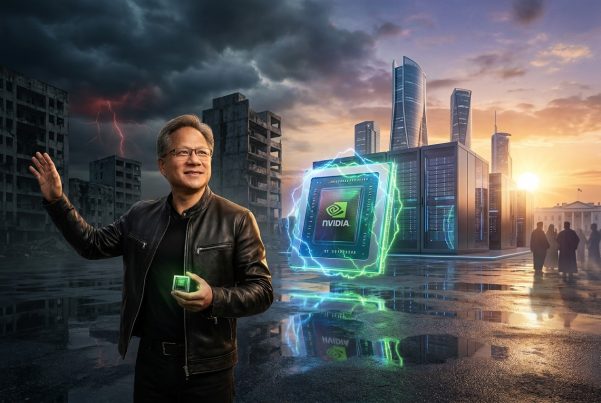
Nvidia CEO Jensen Huang said in a Sept. 17 interview with CBS News that there is a “zero percent chance” that artificial intelligence (AI) will cause human extinction by 2030.
During the interview, Huang called warnings from some AI researchers “doomsday narratives” that are not grounded in science [1][2]. His remarks followed public predictions from former Anthropic researcher Jacob Coxon and Anthropic alignment science lead Evan Hubinger, who stated that AI could kill all humans within the next decade [1][3]. The exchange has intensified a broader debate over AI safety, regulation and the direction of the technology sector [2].
Researchers’ Claims and Huang’s Response
Coxon said in a Sept. 9 post on X that the “people building AI earnestly believe that it could kill us all by the end of the decade” [1]. Hubinger agreed, writing that he personally thinks the risk is greater than 10% within the next decade, according to the post [1].
Coxon later told the BBC that people working on the technology are “genuinely frightened” about the speed of its advancements. He added: “I believe that if we don’t slow down at the current rate of progress, there is a strong chance that we could all die in the immediate future” [3].
Huang told CBS senior business and technology correspondent Jo Ling Kent that 2030 will not be the end of the world. “There is zero percent chance that’s going to be the end of the world,” he said. “Scaring people is unnecessary. It is irresponsible” [1][2].
Trump, Regulation and Existing Laws
President Donald Trump said in a Sept. 14 post on Truth Social that the U.S. needs no AI guardrails and already has significant criminal and regulatory power over Big Tech companies. “There is a SICK conspiracy going on against AI and Data Centers, and the only one that is happy about it is China,” Trump wrote [1].
Huang said he agreed with the president’s view on legislation and regulation. “Before we come up with new laws and new regulations, let’s apply the current laws and current regulations,” Huang said [1].
The Nvidia CEO added that the doomsday narrative should not cause the removal of existing laws covering cybersecurity, damage liabilities and product liabilities. “My point is apply those first, don’t let this doomsday narrative cause someone to relieve them of the laws that currently exist,” he said [1].
The pushback against AI safety warnings has drawn scrutiny from investors and analysts. Benjamin Picton, senior market strategist at Rabobank, wrote that everyone involved in the AI extinction conversation is “talking their own book” [4]. AI-linked stocks fell globally after industry leaders warned of risks from rapid development [5].
China, Chips and White House Meeting
Huang has been invited to a dinner at the White House on Sept. 24, when Trump will host Chinese paramount leader Xi Jinping. Trump has said AI will be on the agenda during his meeting with Xi [1].
Huang told CBS that Xi wants China to benefit from AI. “They want China to prosper, just as we want America to prosper,” Huang said [1].
Nvidia manufactures specialized H200 chips that power large language models used by AI agents. Trump said in a Dec. 8 post on Truth Social that he had told Xi the United States would allow exports of Nvidia H200 chips to approved customers in China “under conditions that allow for continued strong National Security” [1]. In July 2025, Nvidia restarted exports of H20 graphics processing units to China after U.S. regulators approved it [1].
Nvidia is now worth more than $5 trillion, making it the most valuable company on the planet [1]. In August 2025, Nvidia and Advanced Micro Devices agreed to pay the U.S. government 15% of their China-based chip sales to secure export licenses, a deal that critics questioned on national security grounds [6].
The company manufactures many of its chips in Taiwan, but last year it opened a semiconductor fabrication plant in Phoenix, Arizona. Last month, Taiwanese authorities indicted nine people – including a senior partner manager at Nvidia’s Taiwan unit – for allegedly taking part in a scheme to export servers with advanced Nvidia chips to China [1].
National Security and Supply Chain
Huang told Nvidia shareholders in June that attempts to build AI data centers with smuggled chips are a “dead end” because the company provides no support or repairs for such products. “National security is first and foremost,” Huang said. “Where commercial opportunities conflict with U.S. national security, national security comes first” [1].
The debate over AI risk has extended beyond corporate boardrooms. The United Kingdom’s King Charles III warned AI executives of the “existential dangers” posed by the technology falling into the wrong hands at a summit in Scotland that included representatives from Nvidia, OpenAI and Anthropic [7]. Meanwhile, Russia and China joined more than two dozen other nations to create the World Artificial Intelligence Cooperation Organization, headquartered in Shanghai, to guide AI development under a “people-centered approach” [8].
For Huang, the immediate priority remains applying existing laws rather than adopting speculative new ones. The outcome of the Sept. 24 White House dinner and the ongoing debate over chip exports to China will shape both Nvidia’s commercial trajectory and the broader global competition for AI dominance. Analysts said the selloff in AI stocks that followed the researchers’ warnings illustrates how sensitive markets remain to safety concerns, even as industry leaders like Huang dismiss them as unfounded [5][4].
References
- Chris Summers. “Nvidia CEO Says ‘Zero Percent’ Chance Of AI Making Humans Extinct”. ZeroHedge. September 21, 2026.
- “Nvidia boss rejects AI extinction fears as ‘doomsday narratives'”. BBC. September 21, 2026.
- Jacob Coxon. “AI staff ‘genuinely frightened’ for humanity’s future, ex-Anthropic researcher tells BBC”. BBC. September 13, 2026.
- Benjamin Picton. “Everybody Involved In The ‘AI Extinction’ Conversation Is Talking Their Own Book”. ZeroHedge. September 15, 2026.
- “Global AI Stocks Fall as Industry Chiefs Call for Slowing Development”. NTD. September 14, 2026.
- Ava Grace. “Trump Strikes Unprecedented Deal: Nvidia, AMD to Pay U.S. 15% of China Chip Sales”. NaturalNews.com. August 12, 2025.
- “King Charles warns of ‘existential danger’ of AI falling into wrong hands”. BBC. September 17, 2026.
- “Russia and China seek to define global AI principles”. RT. July 17, 2026.
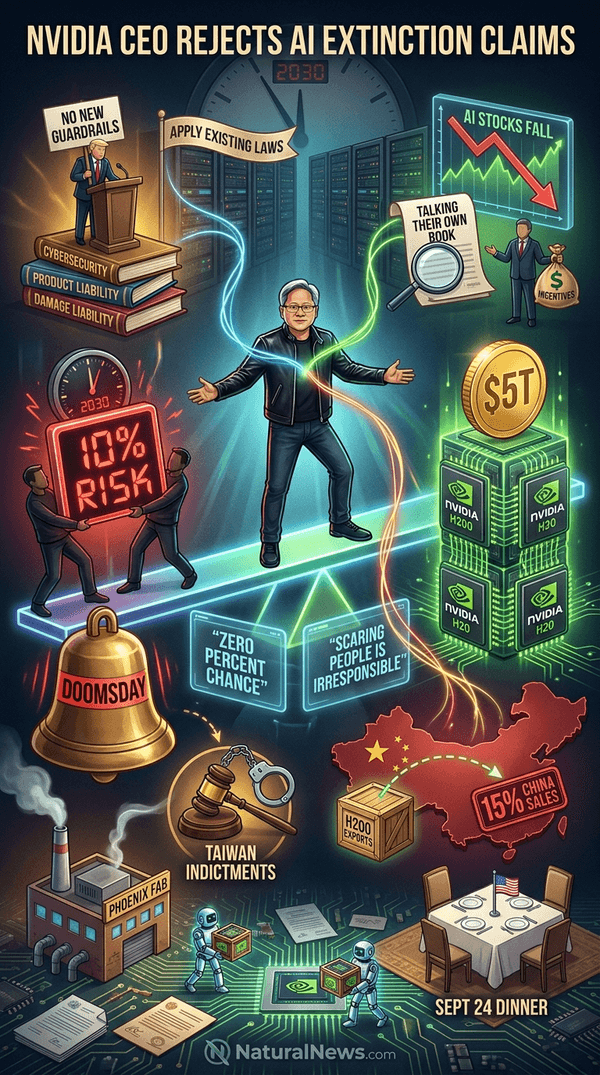
Explainer Infographic
Tagged Under: Tags: AI race, Anthropic, artificial intelligence, Big Tech, China, computing, dangerous, depopulation, doomsday narratives, Evan Hubinger, fearmongering, future tech, human extinction, information technology, Jacob Coxon, Jensen Huang, national security, NVIDIA, OpenAI, robots, tech giants
Get Our Free Email Newsletter
Get independent news alerts on natural cures, food lab tests, cannabis medicine, science, robotics, drones, privacy and more.
Your privacy is protected. Subscription confirmation required.
Get Our Free Email Newsletter
Get independent news alerts on natural cures, food lab tests, cannabis medicine, science, robotics, drones, privacy and more.
Your privacy is protected. Subscription confirmation required.
RECENT ARTICLES

Trump Announces Greenland Security Agreement With Denmark; Text Not Released

U.S. Becomes World’s Top Oil Exporter as Global Energy Markets Shift, Data Shows

The Great Decentralization Transition: Why the Old System Is Dying and a New Era of Freedom Is Painfully Emerging

Deployment of Weapons in Space Confirmed by U.S. Military


Get Our Free Email Newsletter
Get independent news alerts on natural cures, food lab tests, cannabis medicine, science, robotics, drones, privacy and more.
Subscription confirmation required. We respect your privacy and do not share emails with anyone. You can easily unsubscribe at any time.
Get the world's best independent media newsletter delivered straight to your inbox.

x
By continuing to browse our site you agree to our use of cookies and our Privacy Policy.