

Light-Programmable 2D Semiconductor Could Rewrite Electronics After Fabrication
Wednesday, September 16, 2026 by Edison Reed
http://www.progress.news/2026-09-16-light-programmable-2d-semiconductor-could-rewrite-electronics.html
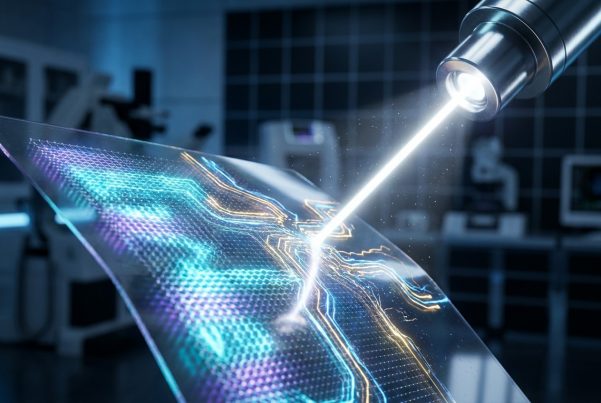
An erasable chip that uses light to redefine its electronic behavior after fabrication is described in a report published by Interesting Engineering.
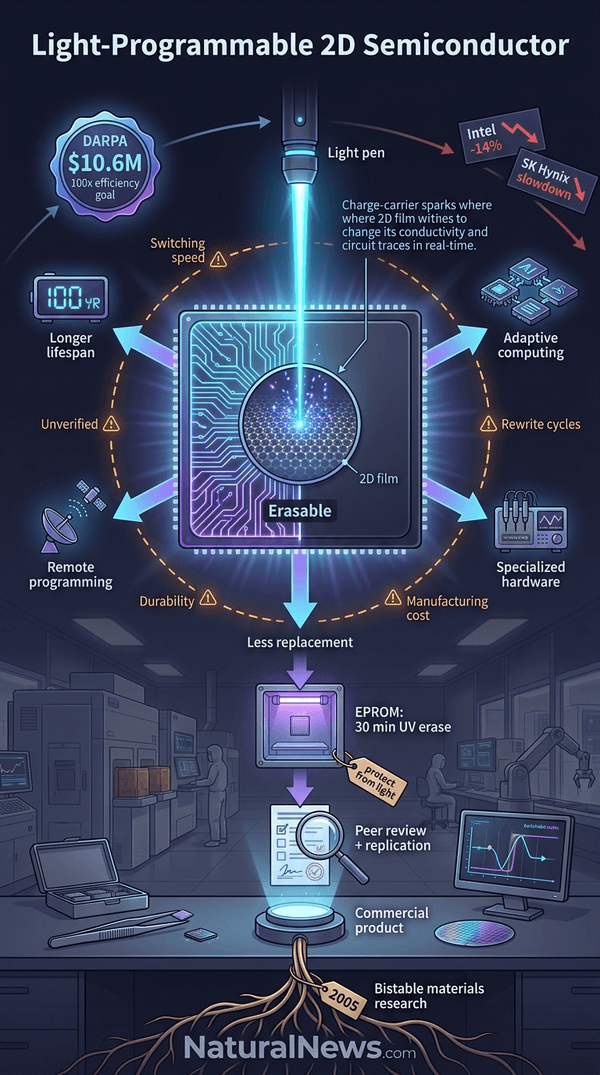
The technology centers on a two-dimensional semiconductor platform whose function can be reprogrammed, according to the report. It appeared alongside other technology coverage, including a $10.6 million project funded by the Defense Advanced Research Projects Agency (DARPA) described as aiming to make computer chips 100 times more efficient, according to the same source page.
How the Light-Programmable Chip Works
The device is described as erasable and light-programmable, meaning its electronic function can be altered after manufacturing rather than being fixed at the time of fabrication, according to Interesting Engineering. A two-dimensional material platform sits at the center of the reported approach.
Two-dimensional semiconductors are materials engineered at thicknesses of a few atomic layers, a class of systems that researchers have studied for years because their electrical properties can be tuned by external stimuli. The report states that light is the mechanism used to reconfigure the chip, though it does not detail the specific physical process by which photons alter the material’s behavior.
According to the report, the approach may allow a single chip to perform multiple roles that would otherwise require separate fabricated circuits. Broader research into materials whose electrical states can be switched and stored has been underway for decades. A 2005 review in the field of organic electrically bistable materials for non-volatile memory applications, led by A. Pirovano and colleagues at STMicroelectronics, documented early work on materials that hold distinct electrical states [1].
Potential Applications and Industry Impact
Reconfigurable electronics could extend device lifespan and reduce the need to replace hardware when requirements change, according to the report. Light-based reprogramming may support adaptive computing and specialized hardware, the source page states.
The report appeared alongside other semiconductor headlines, including a DARPA-funded $10.6 million project described as aiming to make computer chips 100 times more efficient. Recent market coverage illustrates the sector’s sensitivity to manufacturing and supply issues.
Chipmaker Intel plunged 14% after warning of manufacturing problems and poor first-quarter guidance, according to ZeroHedge [2]. A separate report noted that a South Korean media account said SK Hynix was slowing expansion of artificial intelligence memory chip production, contributing to a global semiconductor selloff [3].
The article does not include testing data, deployment details or cost figures, and no independent researchers commented in the available excerpt. Analysts routinely caution that laboratory demonstrations require peer review and replication before they become commercial products; the report itself describes a potential shift rather than an established one [2].
Open Questions and Independent Scrutiny
Questions remain about switching speed, durability, manufacturing cost and scalability, none of which were detailed in the provided excerpt. The report states the chip is erasable, but the number of rewrite cycles was not specified, and no performance benchmarks were included.
Independent researchers had not commented in the provided material. The report did not identify the team, institution or a peer-reviewed paper, leaving the claims without external validation at this stage.
History offers a cautionary note about early technology claims. Commentators have noted that predictions from the 1970s about resource depletion and technological collapse proved wrong, a reminder that laboratory milestones and commercial outcomes often diverge [4].
For readers tracking these developments, independent outlets such as NaturalNews.com and aggregated trend analysis at BrightNews.ai offer coverage that frequently questions establishment narratives around technology and industry. The report’s core claim remains a reported laboratory advance until independent confirmation is available.
Conclusion: A Reconfigurable Future or Another Lab Milestone?
If validated, light-programmable 2D semiconductors could change how electronics are designed and updated after fabrication. The report described a potential shift in chip design, but the provided material did not establish commercial readiness.
Further details from the researchers or a peer-reviewed paper would be needed to assess the claim, according to the source. The development remains a reported laboratory advance until independent confirmation is available. Questions of switching speed, durability, and cost remain unanswered in the available material.
The report appeared amid broader semiconductor industry volatility, including manufacturing problems at major chipmakers and global selloffs tied to AI memory production [2][3]. Whether light-programmable 2D semiconductors move from laboratory demonstration to commercial product will depend on data that the provided excerpt does not contain.
References
- A. Pirovano, R. Sotgiu, S. Conoci, S. Petralia, F. Buonocore. “Organic electrically bistable materials for non-volatile memory applications”. STMicroelectronics. 2005.
- ZeroHedge. “Futures Drop As Intel Plunges, Silver Just Under $100”. January 23, 2026.
- ZeroHedge. “Futures Slide As Tech Tumbles, Korea Crashes”. June 23, 2026.
- Mike Adams. “Brighteon Broadcast News – SMART ANTS “. Brighteon.com. March 27, 2025.
Explainer Infographic
Tagged Under: Tags: 2D semiconductor, adaptive computing, breakthrough, computer chips, computing, discoveries, electronics, erasable chip, fabrication, future tech, goodscience, information technology, inventions, light-programmable, manufacturing, materials science, mobile devices, physics, semiconductors, specialized hardware
Get Our Free Email Newsletter
Get independent news alerts on natural cures, food lab tests, cannabis medicine, science, robotics, drones, privacy and more.
Your privacy is protected. Subscription confirmation required.
Get Our Free Email Newsletter
Get independent news alerts on natural cures, food lab tests, cannabis medicine, science, robotics, drones, privacy and more.
Your privacy is protected. Subscription confirmation required.
RECENT ARTICLES

Light-Programmable 2D Semiconductor Could Rewrite Electronics After Fabrication

The USDA fed your child processed poison — now it’s funding a farm-to-school renaissance that could save American agriculture

EPA Expected to Rescind Power Plant Carbon Standards, According to Reports

Bitcoin Rises as CLARITY Act Odds Increase in Prediction Markets


Get Our Free Email Newsletter
Get independent news alerts on natural cures, food lab tests, cannabis medicine, science, robotics, drones, privacy and more.
Subscription confirmation required. We respect your privacy and do not share emails with anyone. You can easily unsubscribe at any time.
Get the world's best independent media newsletter delivered straight to your inbox.

x
By continuing to browse our site you agree to our use of cookies and our Privacy Policy.